Showing posts with label multiple artists. Show all posts

20 March 2016

Market Square Public Art Program

About Pgh Murals
Spreadsheet of Pittsburgh Public Art and blog archives
Map of Pittsburgh Public Art

The Market Square Public Art Program is a collaboration of the Pittsburgh Downtown Partnership and the Pittsburgh Office of Public Art. Their goal is to bring new, interactive art to the city in the winter. These temporary exhibits will run for a short time each winter over the next few years, bringing something interesting into town to encourage us to venture out in the cold.

2016

Mix-N-Match by Allard van Hoorn uses sound for the primary medium. For several months the artist worked with local groups to create eight sound tracks unique to this space. From local tap dancers to the sounds of brooms sweeping Market Square clean, these unusual and site-specific recordings make an eclectic combination. For detailed information about the various participants and links to the soundtracks, visit the page on Mix-N-Match on the Market Square Public Art Program's website.

In an interview on KDKA's Pittsburgh Today Live, the artist explained that when he looked at Market Square on Google Earth that it looked like a record player to him. He used that as his inspiration to create a giant, interactive record player using the music recorded by those local community groups. The idea was influenced by how the Aborigines in Australia relate to the land through music. Mr Van Hoorn wanted the installation to stimulate people into thinking about how to use public space.

2015

A Winter Landscape Cradling Bits of Sparkle by Jennifer Wen Ma turned Market Square into a small, unique forest. For this display, several different types of trees were used. Small, glass sculptures were scattered throughout adding those Bits of Sparkle. Using Chinese ink, the trees were painted black giving the display contrast and making the emergence of new growth more striking. Some fruit trees were budding at the start of the installation and blooming before it ended.

Unfortunately, we weren't able to get photos while this installation was up.

2014

The first piece in this series, Congregation by KMA, debuted February 21, 2014. For three weeks it became the focal point of Market Square after dusk.

Kit Monkman and Tom Wexler are the artists that make up KMA. They are UK artists that use light and motion to create interactive public art displays. Congregation was introduced in 2010 at the Shanghai World Expo for the UK pavilion. It’s appearance in Market Square marked it’s North American premier.

Visiting Market Square during the day, the only hint you had that anything unusual was there, was a big crane and blank screen off to the side. At dusk though, the motion sensors mounted on that crane worked with the pedestrian traffic in the public space below and images were projected on both the ground and the screen.

Circles appeared around the people and lines of light connected the participants. Abstract shapes and silhouettes joined the mix to produce an interactive form of art using light as the medium. Relationships were created between the individuals, the crowd, and the city itself forming a Congregation.

On their website, KMA explains their idea to illuminate people as Rejecting the historical notion of the citizen as a passive spectator and go on to say KMA’s work celebrates the dynamics of human movement rather than the facets of historic buildings.

When Congregation debuted, the artists posted this on their website:

KMA’s most ambitious work to date, Congregation will be the world’s first ever ballet designed, choreographed and composed entirely for pedestrian performers. There will be no rehearsal and no textual input: participants will simply respond to the choreography of light and sound in an embodied, rather than verbal, discourse. The score for Congregation has been created by Portland-based composer Peter Broderick.

16 January 2016

Blawnox Hoboken Line Mural by multiple artists

About Pgh Murals
Spreadsheet of Pittsburgh Public Art and blog archives
Map of Pittsburgh Public Art

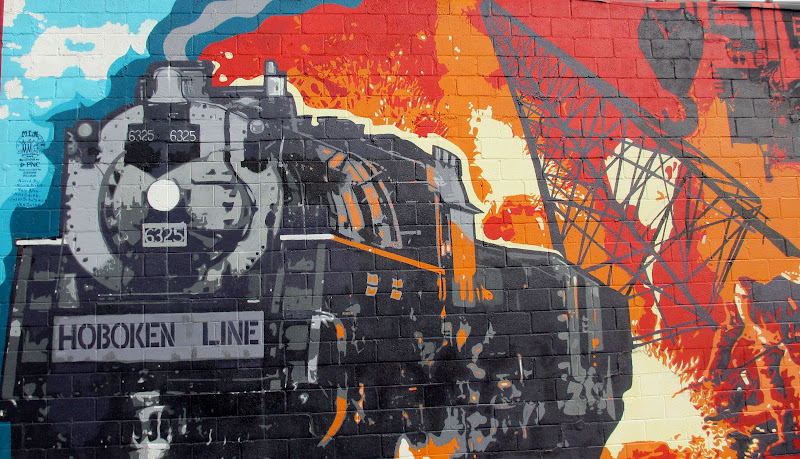
Lucas Stock said that The themes represented are local history and hope for the future. Yuri Von and Ron Esser did historical research on the area’s industry, inventions, architecture including schools, churches, factory buildings, train lines, the companies that operated in Blawnox, the local workforce, working conditions, working class culture and their traditions. The train in the foreground is the Hoboken Line that used to run through the area’s factory lines.

Right away you notice the industrial side on the left half is done in hot colors, with an abrupt transition to the cool blues of the community on the right side. You can almost feel the heat of the mills and the railroad yard on a summer day.

Why does the train say Hoboken?

From Wikipedia:
"The town was originally founded in the late 18th century, with the name Hoboken PA. Steel was the community's major industry, with the area being home to both the Blaw Steel Co. and the Knox Welded and Pressed Steel Co. When the Blaw Steel Co. acquired the Knox Welded and Pressed Steel Co. in 1917, the company became known as the Blaw-Knox Steel Construction Co.

When Hoboken PA was required by the Post Office to change its name because Hoboken, New Jersey had a prior claim to the same name, the management of the Blaw-Knox Steel Construction Co. asked the people of the town to change the name to Blawnox, and the residents did."

Lucas Stock was kind enough to send us a photograph from when they were painting this mural:


Photo by Lucas Stock.

Alphabetasaurus by Carl Goldman, Multiple Artists

About Pgh Murals
Spreadsheet of Pittsburgh Public Art and blog archives
Map of Pittsburgh Public Art

The dinosaurs from the Carnegie Museum’s DinoMite Days were all adopted and moved to their new homes years ago. A handful remain scattered around the city in public places and those are the ones we’ve included in this website.

This is Alphabetasaurus. The letters were done by the students and teachers at Phillips Elementary School on the Southside. Their art teacher, Carl Goldman, oversaw the project.

Metal Petals by multiple artists

About Pgh Murals
Spreadsheet of Pittsburgh Public Art and blog archives
Map of Pittsburgh Public Art

A community group, the Bloomfield–Garfield Corporation, teamed up with ecoDesigners Guild on their Green+Screen project. The goal is to make improvements to empty lots and eyesores in the community. Some projects are designed to screen the clutter or run–down area from view. Other projects work to make physical improvements through landscaping efforts. This is one of the two current art projects built to enhance the space, but made so that they can be relocated if the lot is later developed. This is the other one.

The green in the Green+Screen is for the use of recycled materials and plants. Volunteers work with the community in the design and installation process and try to address their concerns and needs. It's a great idea. We look forward to seeing more of these projects.


Mosaic pavers were created by local children and the benches are supported by scraps collected from cleaning up the lot.

Update
November 2014

Penn Ave has been under construction with the outbound lanes closed for a while now. It was just by chance that we ended up across the street, behind the construction fence and noticed the change in this installation. We don’t know when it was added and we were unable to locate any information about the addition or the artist(s) involved.

15 January 2016

Hamnett Station Park N Ride murals by multiple artists

About Pgh Murals
Spreadsheet of Pittsburgh Public Art and blog archives
Map of Pittsburgh Public Art

This mural's theme was the City of Pittsburgh. Several artists worked on it, including students from Wilkinsburg, and each added something for, or about, the city as they saw fit.

Some close ups of the mural from left to right:

In this section of the mural Jeffrey Katrencik painted his version of Joe Magarak. If you don't know about Joe, you may enjoy reading about the legend of this local steelworker and folk hero.

The creator of this angel is artist Colleen Black. She loves Pittsburgh and told me that she always called it Oz because she thought it was a magical place. Angel of Pittsburgh is modeled after her daughter. She blows fairy dust over the old, polluted city, and on the right side you see it transformed into what we know and love today. She sees Pittsburgh as a city in a constant state of flux, always improving and changing. Although Colleen no longer lives in the area, she left us this angel to show her wishes of love and blessings for our city.

Whitney Ave Art Gallery by Lazae LaSpina, multiple artists

About Pgh Murals
Spreadsheet of Pittsburgh Public Art and blog archives
Map of Pittsburgh Public Art

The Whitney Avenue Art Gallery "Houses in Waiting" program was begun by Lazae LaSpina in 2010 as an effort to spruce up abandoned properties in a Wilkinsburg neighborhood. Professional artists work with neighborhood youths and adult groups to paint what inspires them on the boards that cover windows on these houses.

What a difference the art makes! What is essentially a street filled with sad, abandoned, deteriorated houses doesn't feel so abandoned or derelict anymore. It is window dressing in the true definition of the word, but it does make an emotional difference in how you feel when you ride down this street.

For more information see the article from the Post Gazette and the Whitney Avenue Art Gallery website.

Whitney Ave Tunnel Mural by Andres Ortiz Ferrari, Multiple Artists

About Pgh Murals
Spreadsheet of Pittsburgh Public Art and blog archives
Map of Pittsburgh Public Art

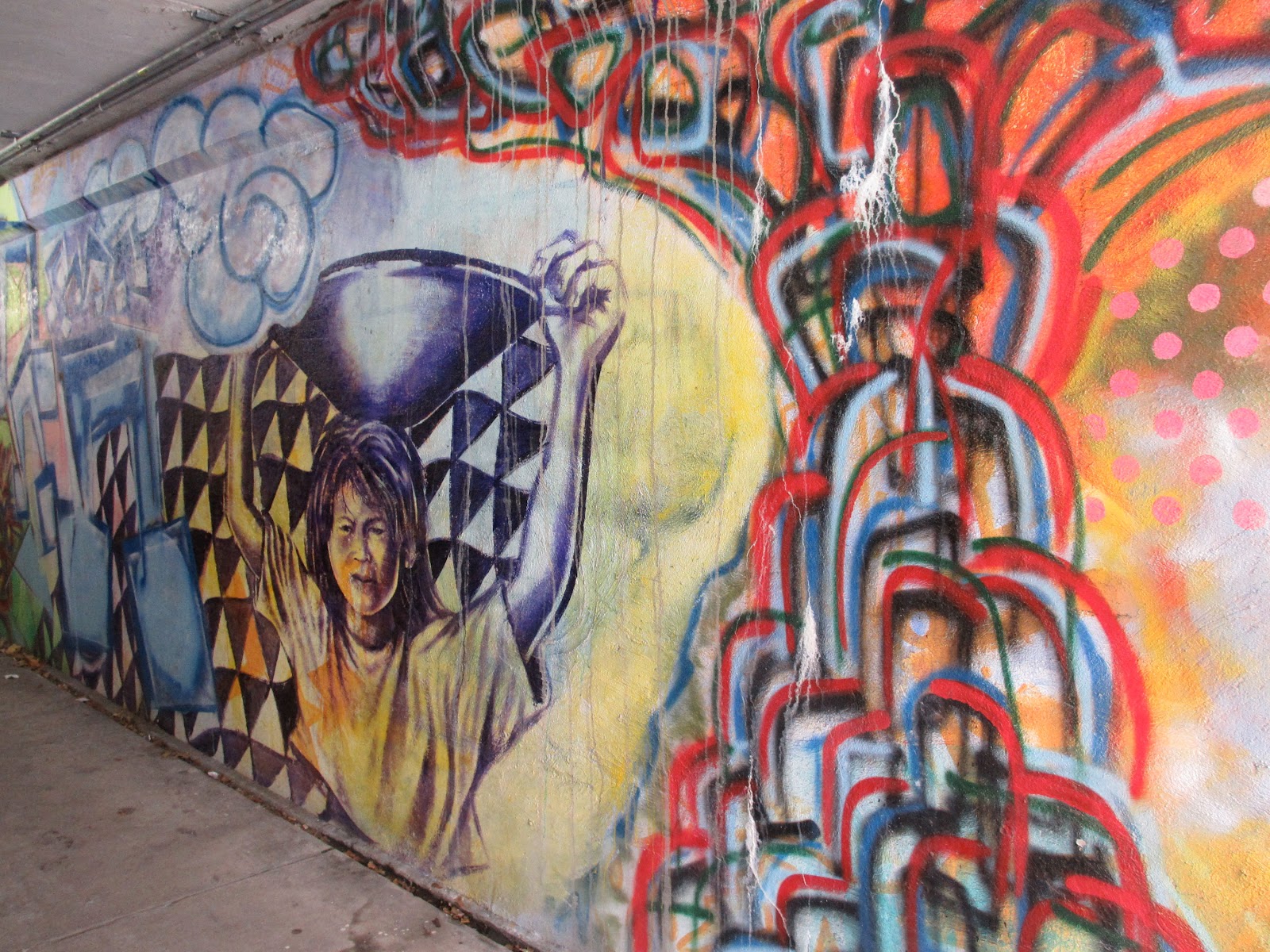
We rode our bikes right past this tunnel one day and didn’t realize what was there. It’s a relatively narrow, 100 foot long, pedestrian walkway that runs beneath the east end busway in Wilkinsburg. It’s not far from the Hamnett Park and Ride in fact (where there’s another mural). We spoke with a couple of the artists that worked on this one and they told us that there were some drainage issues. When they started painting, water leaked in and ruined the artwork. Eventually it was done again with some different paints and now there’s only minor damage evident from the water.

This mural taught some valuable lessons. Much like artist Anthony Purcell discovered when he did Trainscape: Community and Industry, the backers on this mural found out that they failed to consider the entire community’s feelings when this project went forward. Several local philanthropic organizations (The Heinz Endowments, Grable Foundation, Poise Foundation) had their eyes opened when the complaints started to come in and when residents had to be thrown out of a town meeting because the fight over this mural had become so heated. It had never occurred to any of the people involved in approving and financing this mural that it would offend a portion of the local population. Some described it as an eyesore and said that it was no better than graffiti. What they ultimately realized was that there must be more community participation in the decision process. Future projects like this would need to have a credible organization (based within that specific community) to oversee it. The organization used would have to be respected and acceptable to a broad base of the population. Because of what happened with this mural, changes were made to the process for deciding on public art in this and other local communities. In a report from the Heinz Endowments they came to this conclusion: When it comes to art, beauty certainly is in the eye of the beholder. But in a public art setting, the eye of the grant maker needs to be focused on how well artists and project commissioners deal with an entire community of beholders.