Showing posts with label Lucas Stock. Show all posts

29 February 2016

Allentown Mural Asteroid Way by Lucas Stock

About Pgh Murals
Spreadsheet of Pittsburgh Public Art and blog archives
Map of Pittsburgh Public Art

This mural was along the route for the 2013 Pedal Pittsburgh ride, but it was positioned so it was behind you as you rode past it – so it was easily missed. On the return leg of the ride, which passed about a block north, the bright colors jumped out immediately from across a vacant lot. When I stopped at an intersection, a lady standing there with her son noticed where my attention was focused and told me that it was a new mural. She said they had gone over to look at it and thought the subject of it was Puerto Rico.

We had received an email about this mural so I already knew that the themes (provided by the artist, Lucas Stock) were historic landmarks, unique architecture, stained glass art, ethnic and religious symbolism and neighborhood diversity. The artist hadn’t mentioned anything specific about Puerto Rico, but now looking closely at the mural, I could see what looked like the Puerto Rican flag on the right side.

One of the perks of getting directly in touch with an artist is hearing or seeing some of the insight on the design process. In this case, Mr Stock shared some photos he took to document that process:


A pencil sketch of the original design. Photo by Lucas Stock


The filled in sketch. Photo by Lucas Stock


The final product. Photo by Lucas Stock

16 January 2016

Blawnox Hoboken Line Mural by multiple artists

About Pgh Murals
Spreadsheet of Pittsburgh Public Art and blog archives
Map of Pittsburgh Public Art

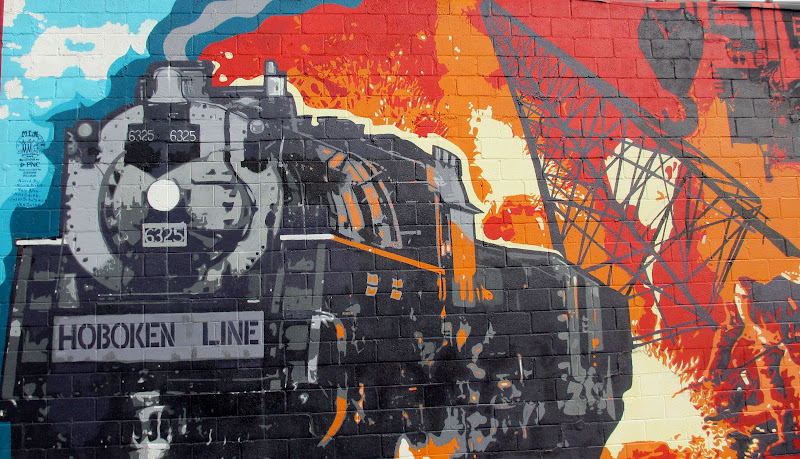
Lucas Stock said that The themes represented are local history and hope for the future. Yuri Von and Ron Esser did historical research on the area’s industry, inventions, architecture including schools, churches, factory buildings, train lines, the companies that operated in Blawnox, the local workforce, working conditions, working class culture and their traditions. The train in the foreground is the Hoboken Line that used to run through the area’s factory lines.

Right away you notice the industrial side on the left half is done in hot colors, with an abrupt transition to the cool blues of the community on the right side. You can almost feel the heat of the mills and the railroad yard on a summer day.

Why does the train say Hoboken?

From Wikipedia:
"The town was originally founded in the late 18th century, with the name Hoboken PA. Steel was the community's major industry, with the area being home to both the Blaw Steel Co. and the Knox Welded and Pressed Steel Co. When the Blaw Steel Co. acquired the Knox Welded and Pressed Steel Co. in 1917, the company became known as the Blaw-Knox Steel Construction Co.

When Hoboken PA was required by the Post Office to change its name because Hoboken, New Jersey had a prior claim to the same name, the management of the Blaw-Knox Steel Construction Co. asked the people of the town to change the name to Blawnox, and the residents did."

Lucas Stock was kind enough to send us a photograph from when they were painting this mural:


Photo by Lucas Stock.

11 January 2016

Wilkinzburg by multiple artists

About Pgh Murals
Spreadsheet of Pittsburgh Public Art and blog archives
Map of Pittsburgh Public Art

Lucas Stock explained this mural as just a graffiti style mural representing the neighborhood. He said that underneath Wilkinzburg J-Town referred to the area near the Johnson School.

06 January 2016

Celestial Weaving Girl by Lucas Stock

About Pgh Murals
Spreadsheet of Pittsburgh Public Art and blog archives
Map of Pittsburgh Public Art

We asked Lucas Stock if he would tell us how he came up with this design and what had influenced his choices. This is his reply:

"After several renditions of the design, I decided to use an art nouveau style of drawing and a bright, bold, mostly solid-color palette to make it stand out and cut down on the amount of shading needed. The imagery features a young, pregnant woman walking across a bridge, she looks carefree, healthy and radiant. There are ribbons of color extending from her hair and she wears a purple dress (to match The Midwife Center logo and sign color) and a purple ribbon around her waist which wraps around into the foreground. On the ribbon is a cross-pattern of female forms showing the line of silhouettes growing from babies to adult pregnant women signifying the cyclical nature of life. The two figures crossing in the center are at the adolescent stage and leap past one another full of youthful energy. The woman on the bridge is followed across the river by a crowd of families, friends and neighborhood residents. The buildings are a mixture of brick buildings, using numerous architectural details from existing buildings throughout the Strip District. The background also depicts a landscape of rolling hills and winding rivers with people enjoying outdoor activities. Prior to painting the final details of the mural were discussed and agreed upon with management and employees of The Sprout Fund for Public Art, The Midwife Center for Birth and Women's Health, a committee from Neighbors In The Strip and neighboring property owners.

Squirrel Hill mural by multiple artists

About Pgh Murals
Spreadsheet of Pittsburgh Public Art and blog archives
Map of Pittsburgh Public Art


This mural with different animals is on the side of a pet store. Our first thought was that it was representing the pet shop, but according to one of it’s designers, this mural is much more than that. Lucas Stock tells us that the themes reflected are multi–culturalism, different languages, use of abstract typography and colorfields and that it’s representing the Squirrel Hill neighborhood’s vibrant shopping district along Murray Avenue, local architecture, art, community and caring for plants and animals.

Remembering Workers, Remembering Veterans by multiple artists

About Pgh Murals
Spreadsheet of Pittsburgh Public Art and blog archives
Map of Pittsburgh Public Art


This tribute to military veterans and to the local veterans of the steel industry is painted on the side of the Veteran’s Leadership Program building. Lucas Stock explained that the figures in the foreground were based on the black and white photography of W. Eugene Smith.

Photo by Lucas Stock

10 November 2015

Persephone by multiple artists

About Pgh Murals
Spreadsheet of Pittsburgh Public Art and blog archives
Map of Pittsburgh Public Art

Another Pittsburgh cyclist called our attention to this mural. As we peddled north on Larimer Ave we could see a house sitting back from the road with almost the entire left side and front porch painted. It was very nice, but it was when we walked around to the far side that my jaw dropped. This was a mural that told a story. A story from Greek mythology actually. The entire house is painted (all four sides) but it's when you look at the north wall that you find the goddess Persephone and the pomegranate that irrevocably bound her to Hades.

As the story goes, Persephone's mother Demeter was basically Mother Earth. Goddess of fruitfulness, fertility and growth, she controlled the bounty and harvest. One day her daughter was abducted by Hades, taken to the underworld, and forced to be his wife – and Persephone's father Zeus was a co-conspirator in the abduction. Demeter wandered the earth in search of her daughter for days. Sad and grieving, she ignored her divine duties and the crops ceased to flourish. In her subsequent anger she refused to restore fertility to the Earth until her daughter was returned. Eventually Zeus had to contact Hades and insist that Persephone be sent back to her mother. Hades relented, but gave Persephone the seeds from a pomegranate, and when she ate them she was forever bound to the underworld. It was decided that she could return to Demeter 2/3 of the year, but she would be forced to spend 1/3 of the year with her husband. Each year when she's sent to Hades, growth stops until her return in the spring.

This mural was designed as a Green Mural. One of the artists, Lucas Stock, explained to us that after painting it, it would

"then have various types of sustainable vine plants and flowers planted around and on top of it, which would eventually grow and cover parts of the mural and the building when in bloom. The landscape design, installation and planting were done by various members of The Pittsburgh Green Team and The Western Pennsylvania Conservancy."

Mr Stock also pointed out some other things in the artwork that we hadn't recognized like large, leafy mandalas, mint leaves, and a tree of life, and said that it’s all meant to represent the cyclic nature of life.

This mural is a continuation of the Persephone mural on the building next door.

06 September 2015

Allentown Stories by Lucas Stock

About Pgh Murals
Spreadsheet of Pittsburgh Public Art and blog archives
Map of Pittsburgh Public Art


In an article at www.sopghreporter.com, they state that this mural
...reflects the innovative roles that the Allentown area of Pittsburgh has played throughout the city's history. The community wanted to portray certain themes such as: local residents and their dedication to the neighborhood, historical landmarks (some that have remained and some that no longer exist,) and also the dynamics involved in the transportation of the areas workforce.

Mr. Stock explained to us that he researched local history in available literature and spoke with many residents about what they remembered about the area's past. Setting out to retell the tales in a visual format, he chose 11 of the most interesting stories and found actual photographic references. He then laid them out in a loose chronological order in 11 sections to fit on the street-front facade of the Caliguiri Highrise.

collage of 10 smaller panels with historic Allentown scenes
photo by Lucas Stock

Mr. Stock said It was important to use pictures that were historically unique to this neighborhood. It's a good way to link younger and older generations of neighborhood residents. It also interplays on the architecture and purpose of the building itself. The Caliguri building has apartments for the elderly as well as a daycare center.

Summary:
Artist(s): Lucas Stock
Address: 813 Warrington Ave
City:Pittsburgh (Allentown)
Zip Code:15210
Organization: Sprout Fund

PghMurals@gmail.com
Twitter: @PghMurals