Showing posts with label history. Show all posts

30 September 2016

South Side Schlumpy Funk by Laura Jean McLaughlin

About Pgh Murals
Spreadsheet of Pittsburgh Public Art and blog archives
Map of Pittsburgh Public Art

Cara and Adam Jette, members of The South Side Slopes Neighborhood Association, saw photos of some step art projects around the world and realized that they had the makings of a step art gallery in their back yard. All of the staircases peppering the Southside Slopes were blank canvases with all sorts of fun possibilities. After months of research, planning, fundraising, and collaboration with local artist Laura Jean McLaughlin, phase one of this master plan became reality.

Oakley St was chosen to be the first stairway for the artistic transformation (with the hope of doing more in the future). Before anything else could be done, the steps needed some TLC. Cara and Adam did the legwork and arranged for the city to make repairs so there would be a good foundation for the artwork.

Laura Jean McLaughlin met with the committee, the community, and the volunteers to create a design that incorporated the ideas of everyone that wanted to help. The first creative session started with everyone doing some art exercises, stimulating the creativity of the group. Then everyone was asked to contribute words or short phrases about the neighborhood.

Once the list was done, each participant was tasked with selecting three or four items from the list to put together an idea for a design. Some of the resulting proposals were very imaginative and fun! They ranged from a poem comprised using only words on the list, to a wide range of images. Many of them included elements from the history of the neighborhood. Some included images of places and things prevalent in the community today. Others creatively blended the words and ideas into eclectic images. In the end Laura Jean McLaughlin took all of the suggestions, all of the words and ideas offered, and produced two designs for the group to chose from. When the designs were presented at the following meeting the group was thrilled. The winning design was selected and a few tweaks were proposed.

From that point, Ms McLaughlin needed to create the full scale design, divide it into 77 horizontal segments, and calculate the amount of each color of tile that would be needed. It would take months to get the tile because the only manufacturer of a frost-proof tile able to endure our climate is in Italy.

The sketch had to be modified somewhat because of the unusual perspective the steps would create. Standing at the bottom and looking up would require some adjustments. Laura Jean tried to compensate for the viewing angle and the fact that each step would most likely obstruct a slice of the step above it until the viewer moved far enough back. There would still be some issues because of the landings in the long staircase, but as the viewer climbs the steps they can easily see the image unfold. One of the modifications Ms McLaughlin made was the elongated neck on the woman. As you walk up the steps it's noticeable, but from the bottom the image looks proportional.

While Ms McLaughlin worked out all of the artistic details, the committee worked on raising sufficient funds. They applied for grants, held fundraising events, and used a crowd funding website to get the donations they needed.

Once the tiles arrived, it was time to gather the volunteers together and teach them how to create the mosaic. Laura Jean McLaughlin manufactured 77 boards, each covered with the design for one of the risers on it. That was overlaid with a strip of mesh for attaching the tiles.

The volunteers were shown how to break the tile using tile nippers and attach the pieces to the mesh with just enough adhesive to hold them in place.

As the installation began, interested started to grow. Pedestrians, cyclists and motorists all paused to admire the work. Many stopped to ask about it and take some pictures. Soon we noticed photos popping up on social media and the response was very positive.

We stopped by while Laura Jean worked with an assistant to install the panels. At this point, she hadn't titled the mural, but she told us the woman in it was Darla. That much she was sure of, but the title was still being elusive. A few days later, as the installation continued, it came to Laura Jean and South Side Schlumpy Funk was named.
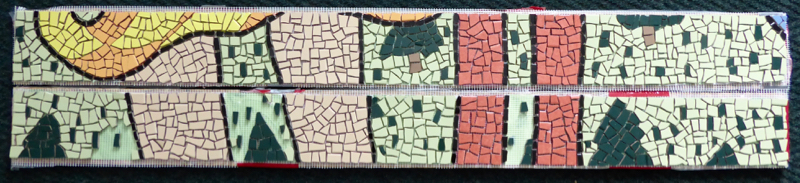
To install the mural, each strip of mesh with the tile attached was carefully cut from the wood. Another board was placed on top of the panel and the entire piece flipped upside down. Thin set mortar was then applied to the back of the tile as well as the step riser, and then the tile panel was pressed into place.

This was a pretty big project and there were a few hurdles along the way. First were the administrative hoops to jump through - getting city approval for the project; getting the art commission to ok the design; getting the steps repaired. Then there was the fundraising. This project was only possible because Laura Jean McLaughlin cut her fee to the bone. She was that excited to take this on. Thanks to her and to all the people that contributed to the Go Fund Me campaign, plus all the volunteers that worked on it - we have a really cool set of stairs in the city now.

There were a lot of volunteers that stepped up and contributed. Too many to list here. More than 40 different people showed up for the meetings and helped break and glue tiles into place. Of course there were a few college students that almost ruined it all when they took one of the steps home to work on and never returned it. Ms McLaughlin had to re-create the design for that step and Cara and Adam came through in the crunch to fill it with tiles while the other steps were being installed.

There were high hopes of having it all installed in time for Step Trek 2016, but the weather didn't cooperate. Several days of rain put things on hold and the mural was only half finished by then. It was worth the wait though. The finished mural is fun, unique, colorful and an amazing accomplishment. The community really pulled together to make this happen. Laura Jean McLaughlin not only wowed us with the design, but did a great job of leading all the volunteers through the process of bringing it to life.

Because of the location of the staircase, there was no way for us to get a good photo without the street sign obstructing part of it. Here are some close ups as you walk up the steps:

09 March 2016

History of Spring Hill Mosaic by Linda Wallen, multiple artists

About Pgh Murals
Spreadsheet of Pittsburgh Public Art and blog archives
Map of Pittsburgh Public Art

After the Children’s Museum of Pittsburgh underwent an extensive remodeling and expansion effort, they sought to broaden their affect on the community. They approached this by linking up with other local organizations and venues to form a collaborative effort. They named this the Charm Bracelet Project, with the various organizations involved represented by individual charms, linked together for a purpose. Since it’s inception, the Charm Bracelet Project has tried to foster and strengthen the Northside community and to encourage creativity on every level. While it celebrates the individuality of the neighborhoods, it also brings them together with activities and a renewed sense of identity.

The bulk of the Charm Bracelet Projects and associated organizations are located in the heart of the old Allegheny City, but a few reach out into nearby neighborhoods. In Spring Hill, this mosaic mural was created as one of their programs.

The mural depicts the history of Spring Hill.

Artist Linda Wallen worked with local high school students in an after school program to create this. They interviewed residents of Spring Hill and researched the history of the area to come up with the design, then spent time at the Manchester Craftsmen’s Guild learning about tile and mosaic work.

Other residents also attended workshops and made their own tiles to be included in the border.

The mural is located in what was a vacant, overgrown lot. It will be the anchor now for a small community park being built there.

Spring Hill was named for having many natural springs in the area. One in particular was located near where the mural was installed. Unfortunately it is now covered over.

Initially home to mostly German immigrants, the mural includes the racing pigeons that they brought with them when they immigrated.

Agriculture was a big part of the history here, and Spring Hill is another of the Pittsburgh neighborhoods that depended on the steps for it’s early residents to go to and from the city below.

The mural and soon to be park are located across the street from the fire hall. We don’t know if this part of the design is a tribute to today’s firemen or yesterday’s, but it seems appropriate for the location.

There are lots of great details and whimsical touches in this mosaic.

29 February 2016

Allentown Mural Asteroid Way by Lucas Stock

About Pgh Murals
Spreadsheet of Pittsburgh Public Art and blog archives
Map of Pittsburgh Public Art

This mural was along the route for the 2013 Pedal Pittsburgh ride, but it was positioned so it was behind you as you rode past it – so it was easily missed. On the return leg of the ride, which passed about a block north, the bright colors jumped out immediately from across a vacant lot. When I stopped at an intersection, a lady standing there with her son noticed where my attention was focused and told me that it was a new mural. She said they had gone over to look at it and thought the subject of it was Puerto Rico.

We had received an email about this mural so I already knew that the themes (provided by the artist, Lucas Stock) were historic landmarks, unique architecture, stained glass art, ethnic and religious symbolism and neighborhood diversity. The artist hadn’t mentioned anything specific about Puerto Rico, but now looking closely at the mural, I could see what looked like the Puerto Rican flag on the right side.

One of the perks of getting directly in touch with an artist is hearing or seeing some of the insight on the design process. In this case, Mr Stock shared some photos he took to document that process:


A pencil sketch of the original design. Photo by Lucas Stock


The filled in sketch. Photo by Lucas Stock


The final product. Photo by Lucas Stock

12 January 2016

Proud of Our Heritage by Rich Boniker, Peter Theofilis

About Pgh Murals
Spreadsheet of Pittsburgh Public Art and blog archives
Map of Pittsburgh Public Art

Traveling southbound on Allegheny River Blvd, this mural depicting elements of Verona’s history will greet you as you enter the business district. It’s just south of the town’s Veterans Memorial Park.

According to a Post–Gazette article by Teresita Kolenchak, the Verona Chamber of Commerce wanted new signs and local artist Rich Boniker suggested the mural. Using the new town slogan Proud of Our Heritage Mr Boniker and fellow artist Peter Theofilis created the mural using the 1971 Verona Centennial Book as a reference. At one time Verona had four train stations and pretty much everything revolved around the railroads.

Painting of a doughboy statue with American Flag.

From 1952 until 2007 Verona had a Doughboy statue in the Veterans Memorial Park about a block from this mural. The statue is included on the left side of the mural.

Steam train engine in front of brick roundhouse.

The rest of the mural is all about the railroad – just as the town was. The crossing sign is not painted on – it’s a sign mounted to the wall. A barge on the river is more background than subject.

Coal barge on the river. RR crossing sign.

The mural makes a very nice welcome sign for Verona and reminds visitors of how important the railroad was to this town, even with it’s proximity to the Allegheny River.

11 January 2016

Dr. Martin Luther King Jr Mural by George Gist, multiple artists

About Pgh Murals
Spreadsheet of Pittsburgh Public Art and blog archives
Map of Pittsburgh Public Art

Feb 17, 2009 was George Gist Day in Pittsburgh, by proclamation of City Council for his inspiration to the community through his art and activism. George Gist is an artist in many mediums. A muralist since 1971, he’s also a Jazz musician. Mr Gist is known for using history and culture in his art. He did a series of charcoal sketches based on photographs taken by Charles Teenie Harris, which we all know are some of the best glimpses into Pittsburgh’s African American history.

Wall and pillars. Images of Dr King, liberty bell, woman doing ballet, people together smiling.

This mural is one of the series of murals installed along the east busway – named after Dr Martin Luther King Jr.   It’s appropriate that there would be a mural in that series to honor Dr King. In this design the central image of The Reverend King is literally made up of many other individuals. As if Dr King existed to speak and represent the many. There is actually fire in his eyes here. Surrounding his image we see visions of what we interpret as Dr King’s dreams for this community: empty jails, laughter, family, friends, music, dance, and an end to the violence and drugs.

Image of Dr King made from hundreds of small figures in shades of blue/green.

The images on the support pillars for the bus shelter are not as easily interpreted. We hope the artists will enlighten us on these designs.

Wall mural and pillars from the right side.

Close up of pillar. Praying, lion head, leaves.

An Amazing Mural Plaza by multiple artists

About Pgh Murals
Spreadsheet of Pittsburgh Public Art and blog archives
Map of Pittsburgh Public Art

Wow! I think that’s what we both said as we rode up to the intersection of Franklin Ave and Wood St in Wilkinsburg. There are five large walls and a gazebo covered in artwork. The buildings are a part of Strength Inc.. They’ve created an outdoor art gallery with some incredible images here. Three of those walls plus the gazebo form a plaza. We feature that group of murals here. We separated the other two walls to their own pages and you can find them here and here.

The artists, Kyle Holbrook, Chris Savido, and George Gist have created a mural that literally surrounds you. The gazebo ceiling is also painted and it’s floor is a tile mosaic.

Starting at the left side and working clockwise around the plaza:

The gazebo ceiling:

The gazebo floor:

UPDATE August 2014
The first two times we visited this grouping of murals there were some other people around in the plaza and the sun was bright. Really bright. So bright that we were unable to get good photos of much of the one wall. We returned recently and this time it was overcast just enough to allow us to get some better pictures, so we’ve replaced several and added a few new ones.
